You Asked One Question. It Did Ten Units of Work.
NERD ALERT - This post takes a peek under the hood of AI.
In my prior post you learned about 'problem decomposition'.
What I didn't mention: AI systems have been doing it automatically for years. It's called fan-out. And once you see it, you can't unsee it.
When you ask ChatGPT, Claude, Perplexity, or Google AI Mode a complex question, it doesn't run a single search against your exact words. Under the hood, the system decomposes your question into 8–12 sub-queries — each targeting a different angle, intent, or dimension of what you asked. Those run in parallel. The results get synthesized into one coherent answer.
You asked one question. The system did ten units of work.
Sound familiar?
The discipline I described in the prior post — the one most marketing organizations skip entirely — is already baked into every serious AI retrieval system on the market. The machines didn't wait for us to figure it out.
What this means practically:
If you're deploying AI agents or building AI-powered analytics inside your organization, fan-out is the architectural equivalent of decomposition. Instead of handing your agent one big ambiguous question, the system should be generating multiple targeted sub-queries against your data before it synthesizes a response.
"Why did campaign performance drop last quarter?" becomes:
→ What changed in delivery pacing by channel?
→ Which audience segments showed the sharpest drop?
→ Were there creative variants that outperformed despite overall decline?
→ What do external benchmarks show for the same period?
→ What does the data say versus what was planned?
Five retrievals. One synthesized answer. Dramatically better output.
The uncomfortable parallel:
Organizations that skip decomposition as a human discipline are also the ones deploying AI systems without fan-out architecture. They're handing a complex question to a system built for structured tasks — and wondering why the answers feel fluent but shallow.
The question isn't whether AI can do this. It's whether your implementation is designed to.
You're Not Ready for Agents Yet
Most AI conversations stay at the surface. This series goes one layer deeper. Agents are coming into your marketing stack. Most teams haven't thought about what to actually hand them.
Gartner recently published it: 40% of enterprise applications will be integrated with task-specific AI agents by the end of 2026, up from less than 5%.
That sounds like a technology story. It's actually a workflow design story.
Because an agent can only execute what's been clearly defined. If you hand it a messy, complex business question — "why did campaign performance drop last quarter?" — you'll get a confident, fluent, partially wrong answer.
The discipline that separates organizations that benefit from agentic AI versus ones that just automate confusion faster? Problem decomposition.
Breaking complex marketing and analytical questions into structured, AI-executable tasks before you run anything. Most organizations skip this entirely.
Quick self-score:
🔴 We don't do this, AI gets the big messy question and hope for the best.
🟡 Occasionally, when someone is thoughtful. Not a standard or repeatable.
🟠 It happens on some projects but it's not baked into how we work.
🟢 Complex questions are always decomposed before AI is deployed. It's a defined discipline — not a personal habit.
Here's what decomposition actually looks like in practice:
"Why did our campaign underperform?" is not an AI task. It's a question made of ten smaller tasks.
Break it down:
→ Isolate the performance drop by channel, audience, and creative variant
→ Compare delivery and pacing against plan
→ Flag anomalies in the data against expected ranges
→ Analyze external factors (seasonality, competitive) for the relevant period
→ Synthesize findings into ranked hypotheses
Now run AI against each discrete task. The output is dramatically better — and reviewable.
The uncomfortable truth:
If the question going in is ambiguous, the answer coming out will be confident and wrong. Agents arriving in your stack don't change that. They amplify it.
The organizations that win in an agentic environment won't be the ones with the most agents. They'll be the ones who've done the unglamorous work of designing the tasks those agents will execute.
Source: Gartner, "Gartner Predicts 40% of Enterprise Apps Will Feature Task-Specific AI Agents by 2026," August 2025.
https://lnkd.in/g42w7p3h
Built for a Crawler. Bought in a Conversation.
LLMs don't click your ads. But they're deciding who gets recommended.
Has your content strategy caught up?
Think about the last time you used ChatGPT, Claude, or Gemini to answer a business question. You didn't get ten blue links. You got an answer. Maybe a shortlist. Maybe a recommendation. Somewhere in that response, a brand either showed up — or didn't.
That decision wasn't made by an algorithm counting backlinks. It was made by a model trained on what's authoritative, structured, and citable — one that decided in seconds whether your organization's thinking was worth surfacing. Most marketing teams have no visibility into that decision. And no strategy to influence it.
Quick self-score:
🔴 We measure clicks, impressions, and traffic. Zero visibility into whether we're being surfaced — or ignored — inside LLM responses.
🟡 We know this is shifting. Nobody owns it. It has no clear home.
🟠 We've started adjusting content. Nothing systematic, nothing measured.
🟢 Content strategy is explicitly engineered for AI recall — named frameworks, credentialed expert attribution, structured original data LLMs can cite.
Here's what HBR research published this month makes clear: when AI-generated summaries appear in search results, clicks to websites drop an average of 47%. In some cases, traffic reductions approach 90%.
That's not a traffic problem. That's a visibility architecture problem.
The organizations winning here aren't producing more content. They're producing content AI systems can use — specific enough to cite, structured enough to recall, distinctive enough to attribute.
The uncomfortable reality:
Your SEO strategy was built for a crawler. The buying decision is increasingly happening in a conversation your brand isn't part of.
You don't need to abandon what's working. You need a strategy built for an audience of one — the model deciding whether your brand is worth citing before your customer ever asks the question.
Where does your organization land?
And if you've started building for LLM visibility — I'd genuinely love to hear how.
Source: Kenny & Pogrebna, "LLMs Are Overtaking Search. Here's How to Adjust Your Online Presence." Harvard Business Review, March 2026. https://lnkd.in/gz-T5qDh
Gemini Doesn't Fix Your Data. It Executes On It.
Nine days from now, Google is putting Gemini inside the tools that run your media budget. DV360. CM360. SA360. Analytics 360. All of it. At once.
On March 23 at their NewFront event, Google will reveal what they're calling "the Gemini advantage in Google Marketing Platform" — an ecosystem-wide upgrade designed to remove fragmentation and activate your data in real time. That's the pitch.
Here's what almost nobody is saying out loud yet.
Gemini doesn't fix your data. It executes on it. Gemini can only remove fragmentation if your data can be unified. And in most marketing organizations right now, it can't.
Misaligned KPI definitions across CM360 and SA360. Agency feeds on weekly cadence while internal dashboards pull daily. Floodlight configurations that were never fully audited. Taxonomy built long ago and not standardized.
Gemini doesn't see that complexity. It sees inputs — and acts on them at AI speed, at media scale, against real budget.
Clean data foundation going in: dramatically better outputs.
Fragmented data foundation going in: confident, fast, and potentially expensive wrong answers.
Quick self-score:
🔴 Highly fragmented — no unified view across platforms, agencies, tools.
🟡 Partially consolidated — significant gaps and manual workarounds.
🟠 Mostly centralized — but taxonomy alignment remains incomplete.
🟢 Clean and governed — structured well enough that an AI layer can optimize toward real outcomes.
There's a second problem that runs deeper.
When Gemini is making real-time bidding decisions inside DV360, the window to catch a data quality problem before it affects spend is essentially closed.
The organizations that benefit from this have defined what "good" looks like before the system runs — named accountability, documented success criteria, clear quality gates. The ones that haven't? The speed of the system becomes a liability, not a true advantage.
The upgrade is coming whether your data foundation is ready or not.
Source: Google, "The Gemini advantage in Google Marketing Platform,"https://lnkd.in/gMdHTRek, February 26, 2026. NewFront livestream: March 23, 11:30 AM ET.
You Don't Have an AI Strategy. You Have a Lottery.
The Scene: Someone opens an AI tool, pastes in a spreadsheet, types a question, and waits for a miracle. Sometimes they get something useful. Sometimes they don't. They run it again. Different output. A colleague tries the same task with a completely different prompt and gets a completely different answer.
So they conclude the tool is inconsistent.
The tool isn't the problem. The input is.
Most organizations treat AI like a vending machine. Put something in. Hope something good comes out. The organizations that are actually winning treat it like a system — where the data is structured deliberately, the context is defined precisely, and the instructions are architected to constrain and focus the output before the model ever touches the analysis.
The difference isn't the AI. It's everything that happens before you hit run.
Quick self-score:
🔴 Raw data, fresh prompt every time — outputs depend entirely on who's typing and what they're thinking that day.
🟡 Some people get consistently great results. Their system lives in their head and their personal accounts — invisible to the organization and impossible to scale.
🟠 Some standards exist in some places. Nobody would call it an architecture.
🟢 Structured inputs, defined context, deliberate instructions. The output is the same regardless of who runs it.
Here's the uncomfortable truth:
If your AI results depend on who wrote the prompt that day, you don't have an AI strategy. You have a lottery.
Repeatability isn't a model problem. It's a design problem. And most organizations haven't designed anything — they've just started prompting.
The gap between yellow and green isn't a better tool. It's a decision to treat input architecture as seriously as the output you're expecting.
Garbage in, garbage out has always been true.
AI just makes the gap between thoughtful and careless input more expensive.
AI Doesn't Create Data Problems. It Reveals Them.
Yesterday, I asked where your data actually stands. Today, let's make it actionable.
In my experience, three core data problems sabotage AI investments more than anything else. They lurk quietly until AI deployment reveals them—often too late.
Here's a clear breakdown:
1) Fragmentation—Your data is scattered across too many silos (e.g., platforms, spreadsheets, or agency feeds), making it unreliable for AI to access and process consistently.
2) Inconsistency—Different teams, partners, or systems define the same KPIs or metrics in varying ways, leading to mismatched inputs and flawed AI outputs.
3) Invisible single points of failure—One critical data source fails (e.g., an API outage or manual update delay), and your entire AI workflow crumbles without warning.
The worst part? Most organizations don't spot these issues until AI amplifies them, wasting time and resources. Before scaling AI into any key workflow, run this quick 5-question audit to uncover and prioritize these problems. It takes just 30 minutes and gives you a clear data roadmap:
1) Where does the data live?
List every platform, agency feed, spreadsheet, or tool involved. If you can't do this in five minutes, fragmentation is already biting you.
2) Who owns each data source?
Name a specific individual—not a team or vendor. No clear owner means no accountability when issues arise.
3) How fresh is the data?
Is it real-time, daily, weekly, or manual? Stale data leads to AI generating confidently incorrect results.
4) How consistent is the taxonomy?
Do all platforms, partners, and teams use the same definitions for KPIs and metrics? Variations cause silent errors in AI reconciliation.
5) What happens if one source fails?
Map out the ripple effects. This reveals hidden single points of failure before they disrupt your AI.
Identify these gaps now, fix them first, and your AI initiatives will thrive—not falter.
Do you know or have a hunch, which of the three problems feels most urgent in your organization?
The Career Risk Nobody's Naming
Let me ask you something uncomfortable.
You've invested in AI tools. You've trained your team. You've planned and built workflows.
But what is your AI actually working with?
The unfortunate reality — there is enormous organizational pressure to accelerate AI implementation. Board mandates. CEO directives. Competitive anxiety.
Move fast. Show results. Now.
And underneath that pressure — largely unspoken:
"We know our data isn't ready. We're building on a shaky foundation. But we can't say that out loud."
Most organizations have a data problem they haven't fully admitted yet.
Not because they don't know it exists.
Because admitting it may feel like a career risk.
Quick self-score - how centralized and governed is your data?
🔴 Highly fragmented — campaign data, customer data, sales data scattered across platforms, agencies, and spreadsheets. No unified view exists.
🟡 Partially centralized — some consolidation but significant gaps, inconsistencies, and manual workarounds remain.
🟠 Mostly centralized with some legacy exceptions that still require manual intervention.
🟢 Fully centralized, governed, and accessible across the organization in near real-time.
Here's the truth nobody wants to say out loud:
You can have the most sophisticated AI stack in your category.
If your data is fragmented — your AI is just automating confusion faster.
Garbage in. Garbage out. Still applies.
The organizations pulling ahead aren't necessarily using better AI models.
They're feeding better data into average ones.
Data centralization isn't a technology project.
It's a competitive decision.
Where does your organization land? Be honest — your AI strategy is only as strong as the data underneath it.
65% of Marketing Tasks. Already Exposed.
The Anthropic study dropped last week. Marketing orgs should be uncomfortable.
Anthropic released the first labor market study built from actual Claude usage data — not theoretical capability, but what AI is doing right now across real occupations.
The finding that should stop every CMO:
Market research analysts and marketing specialists: 65% task exposure.
#5 on Anthropic's most exposed occupations list — above financial analysts, software engineers, and information security professionals.
To put that in context — that's higher than most of the technical roles your organization has already started AI-proofing.
Here's what makes this different from every AI hype cycle you've sat through:
This isn't "AI could theoretically do this." It's observed. Measured. From real usage patterns across real workplaces.
And there's a timing signal buried that almost no one is talking about:
Workers ages 22–25 are already being hired less frequently in high-exposure professions. The unemployment numbers haven't moved yet. But the hiring decisions already have.
That gap — between the hiring shift and the headline numbers — is your window.
Most marketing organizations are still building their AI strategy around tools.
What needs to happen now is an honest look at task composition:
→ Which roles on your team are doing work that AI is already doing at scale?
→ Where are you hiring for tasks that are 65% redundant in 18 months?
→ What's your plan for the people currently in those roles?
This isn't a layoff conversation. It's a design conversation — and the organizations that have it proactively will build something better than what they're replacing.
The ones that wait will be reacting to disruption instead of shaping their response.
Source: Anthropic, "Labor Market Impacts of AI: A New Measure and Early Evidence" — https://lnkd.in/gB9WASj6
You Don't Need Better AI. You Need Better Accountability.
For the past three posts I've been asking hard questions.
Who can prove AI value? Where are you actually starting from? Who owns the output?
Today I want to give you something more useful than a question.
Here's where I would start with any one who's ready to fix the accountability problem:
The 3-Part Fix:
🔴 → 🟢 doesn't happen with better tools.
It happens with three unglamorous decisions:
1. Name the owner — by function.
Not one AI czar for the whole organization. Every function that uses AI to inform decisions needs a named, documented quality owner. Media. Analytics. Strategy. Creative. One person and one accountability for each.
2. Define "good" before you run the workflow.
If success criteria don't exist before AI executes — no one can meaningfully review what comes out. This is a standards problem disguised as a technology problem.
3. Build a QA gate — lightweight but non-negotiable.
One reviewer. Documented criteria. One sign-off before AI output influences a real decision. Not a committee. Not bureaucracy. A checkpoint.
Here's the reframe that changes everything:
Most organizations treat AI output like Google search results.
Probably right. Act on it.
The organizations that will win treat AI output like an agency recommendation.
Valuable input. Still requires human judgment before it moves.
The uncomfortable reality:
You don't need better AI.
You need better accountability structures around the AI you already have.
Which of the three from above feels most urgent for your organization right now?
The Question That Silences Rooms
Ask this question and there’s a good chance the room will get quiet.
"Who in your organization is ultimately responsible for the quality and accuracy of AI-generated outputs?"
Not who uses AI. Not who bought the tools.
Who actually owns the output and is assuring accuracy?
Quick self-score:
🔴 No one. Whoever runs the workflow takes informal responsibility — if anyone does.
🟡 Team leads review outputs loosely but there are no defined standards or accountability.
🟠 There's a general sense of ownership but it isn't documented or consistently enforced.
🟢 A defined quality owner exists with documented criteria applied before any output drives a decision.
Here's the uncomfortable truth:
Most organizations are 🔴 red or 🟡 yellow.
Which means AI-generated insights are informing real decisions — budget allocations, campaign strategies, audience targeting — with no one formally accountable for whether they're right.
That's not an AI problem. That's a leadership problem.
The organizations that will win in an AI-first market aren't necessarily the ones with the best tools.
They're the ones who know who's responsible when the tools get it wrong.
You Can't Close a Gap You Can't See
Be honest with yourself for a moment.
When you look across your organization today — how would you describe your relationship with AI?
Not your ambition. Not your roadmap.
Right now. Today!
Quick self-score:
🔴 Mostly individual experimentation — ChatGPT, Copilot, whatever someone found on their own. No organizational approach.
🟡 AI exists in specific pockets — but inconsistent across teams with no shared standards.
🟠 Actively used across multiple functions with some governance starting to emerge.
🟢 Deeply embedded — consistently tied to measurable business outcomes across the organization.
Here's what I've observed;
Most think they're 🟠orange.
Most are actually 🟡yellow.
Few are honest enough — or lack enough visibility — to know the difference.
That gap between perceived maturity and actual maturity? You can't close a gap you can't see.
Can You Prove It?
The AI Readiness Reality Check:
Most organizations are running AI experiments.
Very few are running AI-native businesses.
Here's the question that separates them:
"Can you point to a specific business outcome — revenue, performance, cost, speed — directly attributable to AI?"
Not "we're using it." Not "the team loves it."
Proof.
Quick self-score. Pick your honest answer:
🔴 "We can't quantify it — AI is happening but no one's tracking outcomes."
🟡 "We sense it's contributing but haven't connected it to real metrics."
🟠 "We have data points in specific areas but nothing systematic."
🟢 "We actively track AI's contribution against defined KPIs every quarter."
Most organizations will likely fall somewhere between 🔴red and 🟡yellow.
Not because they lack smart people.
Because no one defined success before AI got deployed. No one owns the measurement. AI was brought in to impress — not to activate.
That's the gap. And it's fixable.
I Built a RAG Agent Over the Weekend
My mind is officially blown. Out of boredom, I built a RAG agent over this past weekend. What hit me hardest (even by my own benchmarks) is how quickly this tech is forcing every serious team to re-architect on the fly.
What started as a simple data processing idea turned into a full end-to-end pipeline: drop an Excel template → auto-chunk/embed into Supabase vector store → instant agentic analysis and classification → export clean CSV output to Google Drive → plus an always-on chat agent with memory and citations.
The real jaw-dropper? n8n's built-in AI-assisted builder and agent nodes let you visually orchestrate complex logic like it's Lego. The AI built it all by itself - just by me prompting!
Supabase's pgvector integration makes self-hosted, production-grade vector search feel effortless (no separate Pinecone/Weaviate needed). Again, the built-in AI built the vector stores and chat memory needed for my project.
The killer feature: export any workflow as clean JSON → paste it into Grok, Claude, GPT, or Gemini → describe tweaks or entirely new use cases → get back updated/brand-new import-ready JSON in seconds.
Iterating went from hours of node-dragging to minutes of natural-language prompting. Allowed me to accelerate the the whole process: describe → generate → import → test → refine.
Gang - this isn't just tooling - it's a glimpse of the foundational shift AI is forcing on every organization. The capabilities are arriving faster than most teams can restructure around them. Companies that treat automation + agents as a core competency (not an IT side project) will pull ahead dramatically. The rest risk being left behind or playing a game of catch up.
If you're experimenting with AI workflows, RAG agents, or no-code/low-code orchestration - what's blowing your mind right now? Drop a comment—I'd love to hear your wins, war stories, or next experiments.
(Pro tip: If you're on n8n, try exporting a workflow and feeding it to your favorite frontier model. The loop is addictive.)
#AI #Automation #RAG #n8n #Supabase #AgenticAI #NoCode #FutureOfWork #LLM
Building on Sand
AI hype is deafening in 2026… but most results stay silent.
Everyone’s rushing AI pilots, agents, and “smart” dashboards—yet the majority quietly flop.
The hard truth: AI fails without rock-solid data integration + ontology.
It’s not table stakes; it’s the entire game.
Read on for why foundations beat fancy LLMs every time—and what to build first 👇
The AI hype is loud… but the foundation is silent.
Everyone’s racing to launch AI pilots, copilots, agents, dashboards that “talk.” Yet most initiatives quietly under-deliver.
Why? Because we keep building on sand.
The hard truth: AI’s promise collapses without rock-solid data integration and ontology.
What actually matters first — the real priority:
Connecting disparate data sources
Cleaning and normalizing the mess (with real data checks and cross-checks)
Building the semantic layers (ontologies) that define:
• Business rules and context
• Relationships between entities
• A shared glossary and taxonomy
• True meaning — how the business actually operates
It’s not glamorous. It’s not flashy.
It’s the invisible plumbing that turns chaos into clarity.
But once that foundation is in place — once your data is connected, trusted, and semantically rich — everything changes.
You can finally layer on, with confidence:
• Real-time analytics
• Executive dashboards that actually mean something
• Machine learning models that learn the right things
• Generative AI that delivers trustworthy, contextual answers
No more garbage-in, gospel-out.
No more “the AI said…” followed by boardroom eye-rolls.
The winners in the next decade won’t be the ones with the fanciest LLMs. They’ll be the ones that quietly nailed the data foundation years earlier.
Data integration and ontology aren’t “table stakes.”
They’re the entire game.
If you’re leading digital or AI transformation, ask yourself:
Are we still skipping the foundation… or finally building it right?
Finally. A Map for the AI Chaos.
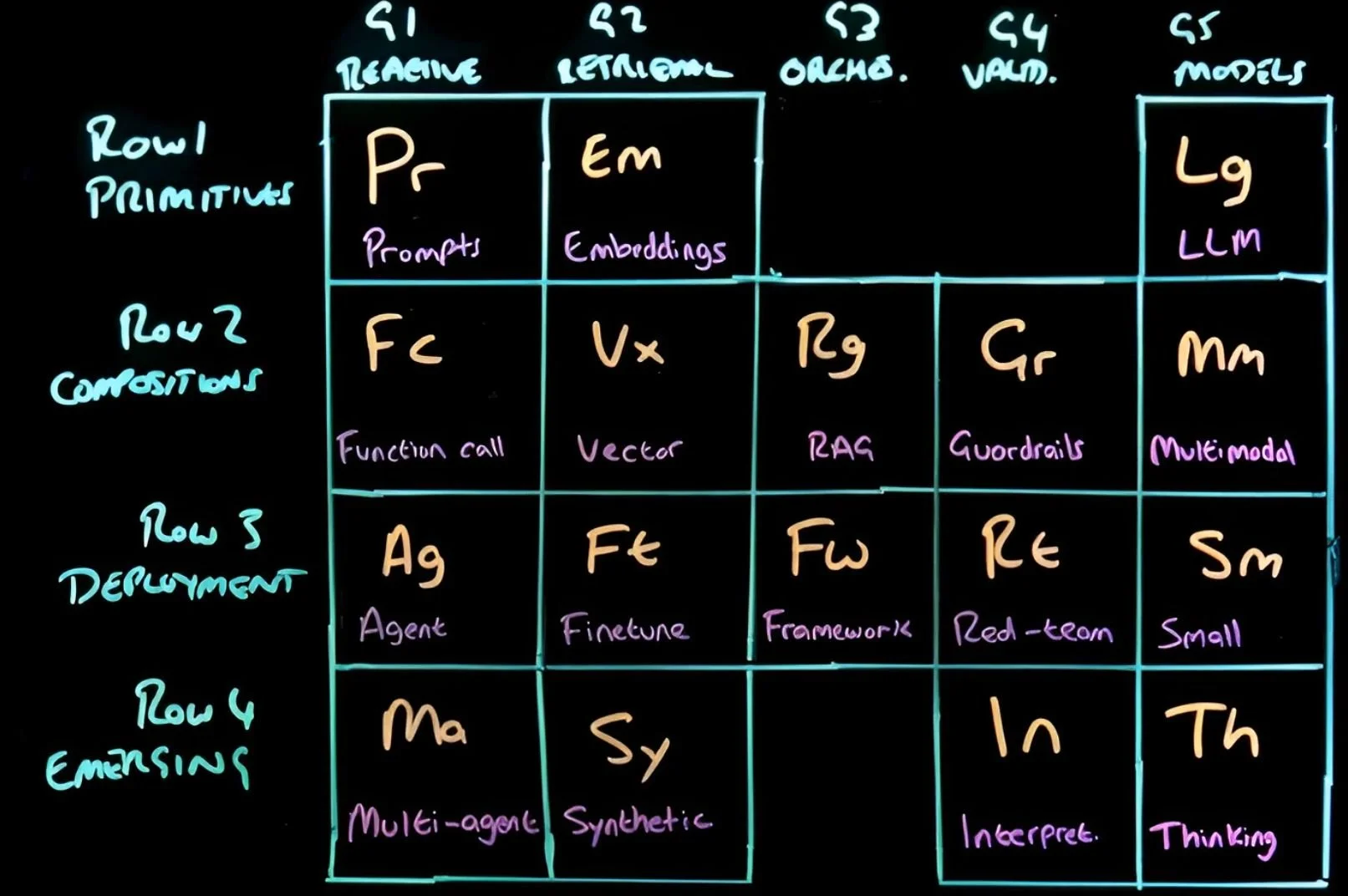
AI buzzwords blur fast: prompts, RAG, agents, guardrails, embeddings... total overload.
I recently watched Martin Keen's IBM video on the "AI Periodic Table" (link below). It's offers a brilliant mental model that organizes these concepts like the chemical periodic table.
Rows build from basics to advanced (Primitives, Compositions, Deployment, and Emerging) and the columns group by family (Reactive, Retrieval, Orchestration, Validation, Models).
The magic? It lets you decompose any AI app or project into its core "elements." After watching the video, I encourage you to map out what you're building (or evaluating), spot gaps (missing guardrails?), uncover smart combos, and predict how components interact - like chemical reactions. Have fun with it!
I've used it personally to break down my own projects: drop components onto the grid, identify missing pieces, and clarify the architecture fast. It turns hype into something structured and actionable.
Watch the video here: https://www.youtube.com/watch?v=ESBMgZHzfG0
What's one AI project or use case are you tackling right now? Try mapping it to the table - what elements are in play, and what's missing?